
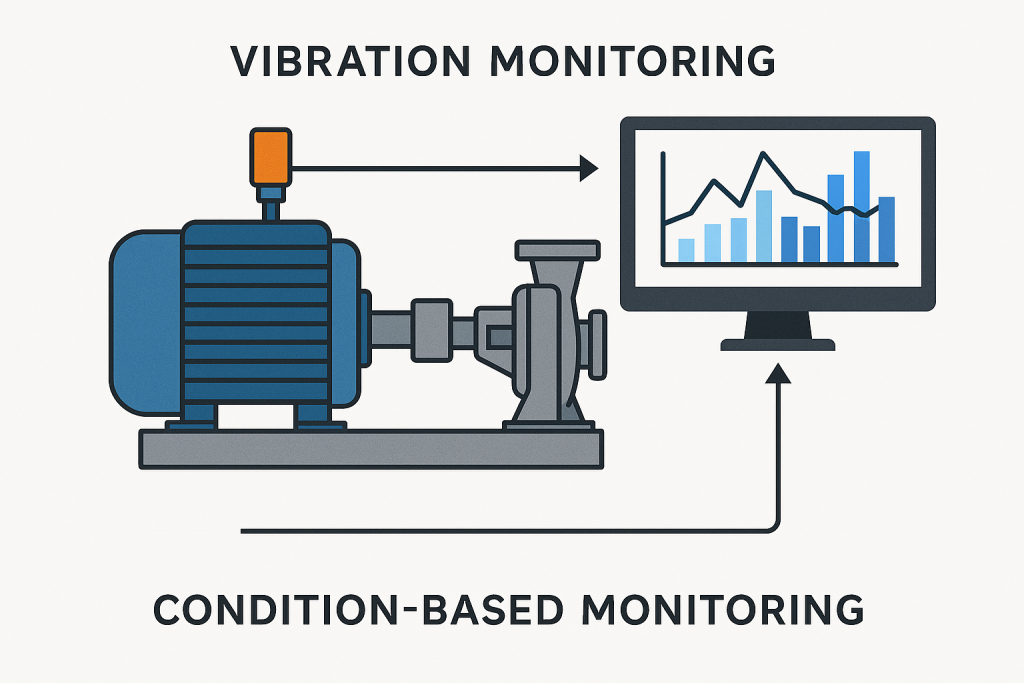
Vibration plays a crucial role in condition-based monitoring (CBM), particularly for rotating machinery such as motors, pumps, fans, and gearboxes. It serves multiple purposes and is highly effective for monitoring.
Vibration monitoring involves measuring the oscillations of a machine or component over time. These oscillations can reveal a lot about the machine’s health, especially when compared to baseline data. Some of the benefits include:
Early Fault Detection: Vibration patterns change when components like bearings, shafts, or gears begin to wear or fail.
Non-Invasive: Sensors can be mounted externally, allowing for continuous monitoring without interrupting operations.
Predictive Maintenance: Helps schedule maintenance before a failure occurs, reducing downtime and costs.
Versatile: Applicable to a wide range of equipment and industries.
To monitor vibration effectively, several key parameters are measured:
Frequency: Helps identify the source of the vibration (e.g., imbalance, misalignment, bearing faults).
Phase: Useful for diagnosing complex issues like resonance or looseness.
Common faults detected include:
Bearing wear
Gear mesh issues
Shaft misalignment
Rotor imbalance
Looseness or structural resonance
To support condition-based monitoring with vibration, several tools and techniques are commonly used:
FFT (Fast Fourier Transform): Converts time-domain data into frequency domain for easier fault identification.
Envelope Analysis: Useful for detecting bearing faults.
Trend Analysis: Tracks changes over time to predict failures.
Industries such as manufacturing, oil and gas, and power generation rely on condition-based monitoring to track the health and performance of critical assets.
By combining Otoni AI condition-based monitoring with CMMS capabilities, you gain a powerful solution to maintain productivity